
Top 10 Best AI Platforms Reviewed in 2026
- May 4, 2026
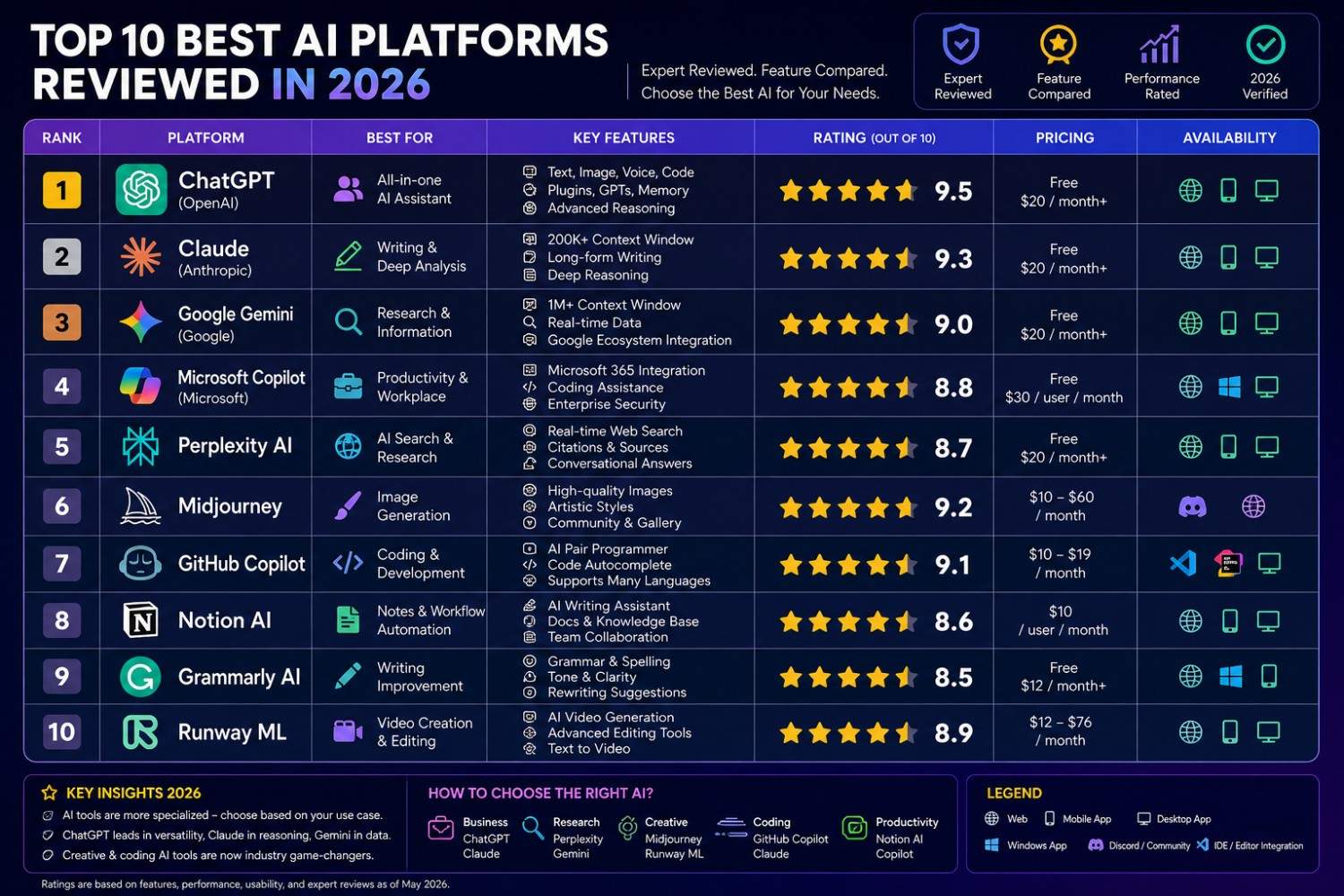
The 10 Best AI Tools Reviewed in 2026 (A Full Guide)
Artificial intelligence has become an essential business tool rather than a futuristic concept. Organizations across industries now depend on AI platforms to automate tasks, analyze data, and improve decision-making. However, choosing the right platform from dozens of options can feel overwhelming.
This guide examines the ten leading AI platforms in 2026, helping you understand what each offers and which fits your specific needs. We’ve tested these platforms ourselves, analyzing their features, pricing, and real-world performance to give you accurate, actionable information.
What Makes an AI Platform Different from AI Tools
Before diving into specific platforms, understanding the distinction between AI platforms and AI tools helps clarify your options.
AI platforms provide complete environments where you can build, customize, and manage AI systems. They offer infrastructure like machine learning capabilities, natural language processing, and integration options. Data scientists and business teams use these platforms to create tailored solutions.
AI tools, on the other hand, are ready-made applications designed for specific tasks. They solve particular problems right out of the box without requiring customization or technical expertise.
Most businesses benefit from using both: platforms for building custom solutions and tools for immediate, specific needs.
How We Evaluated These Platforms
Our evaluation process examined several critical factors to ensure fair, useful comparisons. We tested each platform’s core functionality, looking at data processing speed, accuracy, and reliability. User experience mattered too, including interface design, learning curve, and documentation quality.
We also considered integration capabilities, pricing transparency, customer support responsiveness, and real user feedback from verified customers. Each platform earned scores across these categories, with core functionality and standout features weighted most heavily.
The Top 10 AI Platforms for 2026
ChatGPT (OpenAI) – Best for General-Purpose AI Tasks
ChatGPT leads the pack for versatility and ease of use. The GPT-4 model powers conversations, content creation, code generation, and data analysis through a simple chat interface.
Key strengths: Natural language understanding, multi-modal capabilities (text, images, voice), extensive plugin ecosystem, and Custom GPTs for specialized tasks.
Pricing: Free plan available; Plus plan at $20/month; Team plan at $25/user/month; Enterprise pricing available.
Best for: Small businesses, content creators, developers, and teams needing a flexible all-purpose assistant.
The platform excels at breaking down complex topics, generating creative content, and solving problems across domains without specialized training.
Claude (Anthropic) – Best for Complex Reasoning and Document Analysis
Claude stands out for handling long documents and nuanced reasoning tasks. The platform processes up to 200,000 tokens, allowing you to upload entire books or codebases for analysis.
Key strengths: Superior document comprehension, thoughtful responses, strong coding abilities, and safer outputs with reduced hallucinations.
Pricing: Free plan available; Pro plan at $20/month; Team plan at $25/user/month.
Best for: Researchers, legal professionals, technical writers, and anyone working with large documents.
Claude’s measured approach produces more reliable results for tasks requiring accuracy and depth over speed.
Google Gemini – Best for Multimodal AI and Workspace Integration
Gemini integrates directly with Google Workspace, making it powerful for users already in that ecosystem. The platform handles text, images, audio, and video in a single conversation.
Key strengths: Native Google app integration, strong multimodal understanding, real-time information access, and collaboration features.
Pricing: Free plan available; Advanced plan at $19.99/month; Business and Enterprise tiers available.
Best for: Google Workspace users, teams needing multimodal AI, and organizations requiring real-time data access.
The workspace integration lets you analyze Gmail threads, summarize Google Docs, and process Google Sheets data without switching tools.
Perplexity AI – Best for Research and Information Discovery
Perplexity focuses on research, providing cited answers with source attribution. The platform combines search capabilities with AI analysis, offering a research assistant experience.
Key strengths: Source citations, real-time web access, follow-up questions, and focused research mode.
Pricing: Free plan available; Pro plan at $20/month.
Best for: Researchers, journalists, students, and professionals conducting market research or competitive analysis.
Perplexity shines when you need verifiable information backed by sources rather than generated content.
Lindy – Best for Custom AI Automation and Workflows
Lindy allows non-technical users to build AI agents that automate business processes. The platform offers templates for common tasks like email management, lead generation, and meeting scheduling.
Key strengths: No-code agent builder, 2,500+ integrations, voice capabilities, and workflow automation.
Pricing: Free plan with 400 credits/month; Pro plan at $49.99/month.
Best for: Operations teams, sales departments, customer support, and anyone automating repetitive tasks.
The platform bridges the gap between simple chatbots and complex automation tools, making AI accessible to business users
.
Microsoft Copilot – Best for Enterprise Productivity
Microsoft Copilot embeds AI directly into Office applications, Windows, and Edge browser. The enterprise version accesses your organization’s data while maintaining security and compliance.
Key strengths: Deep Microsoft 365 integration, enterprise security, data governance, and admin controls.
Pricing: Included with some Microsoft 365 plans; Copilot for Microsoft 365 at $30/user/month.
Best for: Large organizations, Microsoft-centric companies, and teams prioritizing data security.
Copilot works within familiar tools, reducing the learning curve and increasing adoption rates.
Jasper AI – Best for Marketing Content Creation
Jasper specializes in marketing copy, maintaining brand voice across campaigns. The platform offers templates for ads, social media, blogs, and email campaigns.
Key strengths: Brand voice training, marketing templates, SEO optimization, and team collaboration.
Pricing: Creator plan at $49/month; Pro plan at $69/user/month; Business plan with custom pricing.
Best for: Marketing teams, agencies, content creators, and brands producing high-volume content.
The platform helps maintain consistency across channels while scaling content production.
Synthesia – Best for AI Video Generation
Synthesia creates professional videos from text scripts using AI avatars. The platform supports 140+ languages and offers customizable avatars and templates.
Key strengths: No filming required, multilingual support, custom avatars, and quick production time.
Pricing: Starter plan at $29/month; Creator plan at $89/month; Enterprise pricing available.
Best for: Training departments, marketing teams, and organizations creating multilingual content.
Synthesia removes technical barriers to video production, making professional content accessible to any team.
DataRobot – Best for Automated Machine Learning
DataRobot automates the machine learning pipeline, from data preparation to model deployment. The platform serves data scientists and business analysts building predictive models.
Key strengths: Automated feature engineering, model selection, deployment tools, and explainable AI.
Pricing: Custom enterprise pricing.
Best for: Data science teams, analytics departments, and organizations building custom ML models.
The platform democratizes machine learning, allowing teams without deep expertise to build production-grade models.
Adobe Firefly – Best for Creative Content Generation
Adobe Firefly generates images, graphics, and design elements trained on licensed content. The platform integrates with Adobe Creative Cloud applications.
Key strengths: Commercial-safe outputs, Creative Cloud integration, style matching, and content credentials.
Pricing: Free plan available; Premium plan at $9.99/month.
Best for: Designers, marketing teams, and creative professionals needing commercial-safe imagery.
Firefly’s ethical training approach addresses copyright concerns that plague other image generators.
Choosing the Right Platform for Your Needs
Selecting an AI platform depends on your specific requirements, team size, and technical capabilities.
Small businesses often benefit from versatile, affordable options like ChatGPT or Claude. These platforms offer broad functionality without requiring technical expertise or large budgets.
Medium-sized companies might combine general-purpose platforms with specialized tools. For example, using ChatGPT for general tasks while leveraging Jasper for marketing content or Lindy for workflow automation.
Enterprise organizations typically need platforms offering security, compliance, and integration with existing systems. Microsoft Copilot, Google Gemini, or DataRobot often fit these requirements better.
Consider your industry too. Healthcare organizations need HIPAA-compliant options. Financial services require robust security and audit trails. Creative agencies prioritize copyright-safe content generation.
Making Your Decision
The AI platform landscape continues evolving rapidly, with new features and capabilities launching regularly. Start by identifying your primary use case, whether that’s content creation, data analysis, customer service, or workflow automation.
Test free plans when available. Most platforms offer trial periods or limited free tiers, letting you evaluate fit before committing financially. Pay attention to how well each platform integrates with your existing tools and workflows.
Remember that many professionals use multiple platforms simultaneously. ChatGPT might handle general queries, Perplexity could support research tasks, and a specialized tool like Synthesia might create video content. This multi-platform approach often delivers better results than trying to force one tool to handle everything.
The right AI platform becomes a force multiplier for your team, handling routine tasks while freeing people for strategic thinking and creative problem-solving. Choose based on your actual needs rather than marketing hype, and you’ll find significant value regardless of which platform you select.
Frequently Asked Questions (FAQs)
The best AI platform in 2026 depends on your use case. ChatGPT/GPT-5 leads for general-purpose tasks, Claude excels at complex reasoning, and Google Gemini dominates multimodal applications.
AI platform costs range from free plans to $20-100+ per user per month. ChatGPT Plus costs $20/month, enterprise solutions like DataRobot require custom pricing.
Yes, most professionals use 2-3 AI platforms simultaneously. Common combinations include ChatGPT for writing, Perplexity for research, and specialized tools like Synthesia for video.
ChatGPT Plus ($20/month), Claude Pro ($20/month), and Lindy (starting at $39.99/month) offer the best value for small businesses with powerful features and affordable pricing.
Enterprise-grade AI platforms offer SOC 2 compliance, GDPR compliance, and data encryption. Always verify security certifications before uploading sensitive business data.
No, most modern AI platforms like ChatGPT, Claude, and Jasper require no coding. However, advanced platforms like DataRobot and API-based tools may require technical expertise.
AI platforms provide comprehensive environments for building AI systems, while AI tools are ready-made applications for specific tasks. Platforms offer more customization and integration capabilities.
Enterprise platforms like Microsoft Copilot and DataRobot offer 24/7 support and dedicated account managers. ChatGPT and Claude provide community support with paid priority options.